
Coldwater Streams
Contributors
Michigan Department of Natural Resources
Recommended Citation: Kevin E. Wehrly, Dana K. Castle, Arthur R. Cooper, Ryan E. Brown, Tim A. Cwalinski, Edward A. Eisch, Patrick B. Ertel, Jan-Michael Hessenauer, Addie J. Myers, Lucas R. Nathan, Jack E. Taylor, Mark A. Tonello, Jay K. Wesley, and Troy G. Zorn. 2026. Michigan’s Wildlife Action Plan: 2025-2035, Coldwater Streams. Michigan Department of Natural Resources, Lansing, MI.
What are coldwater streams?
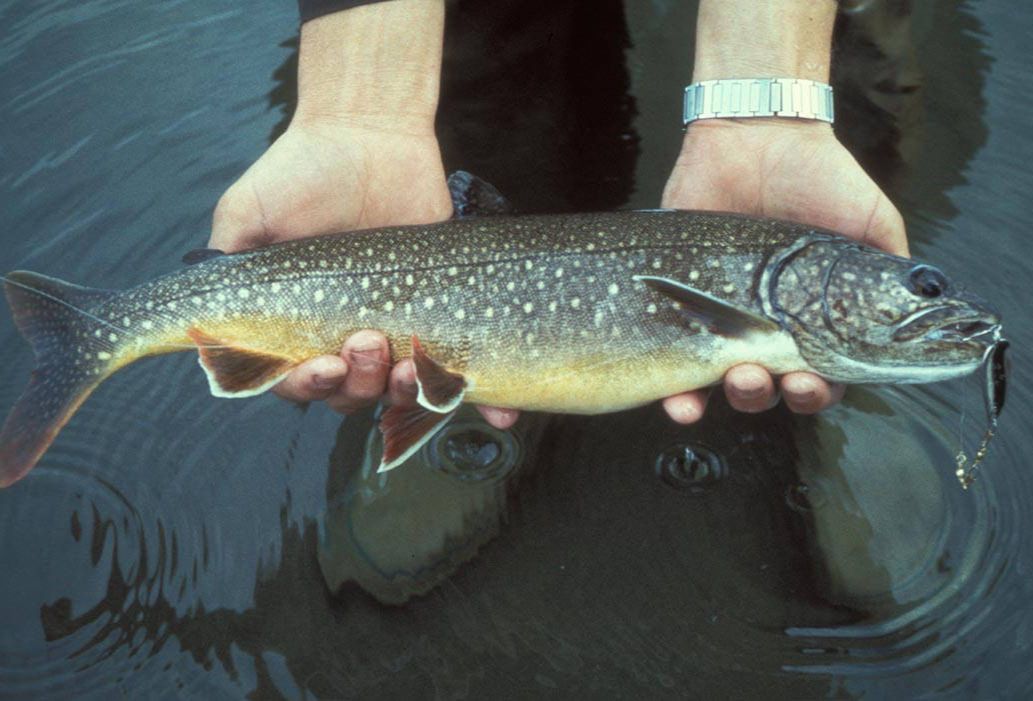
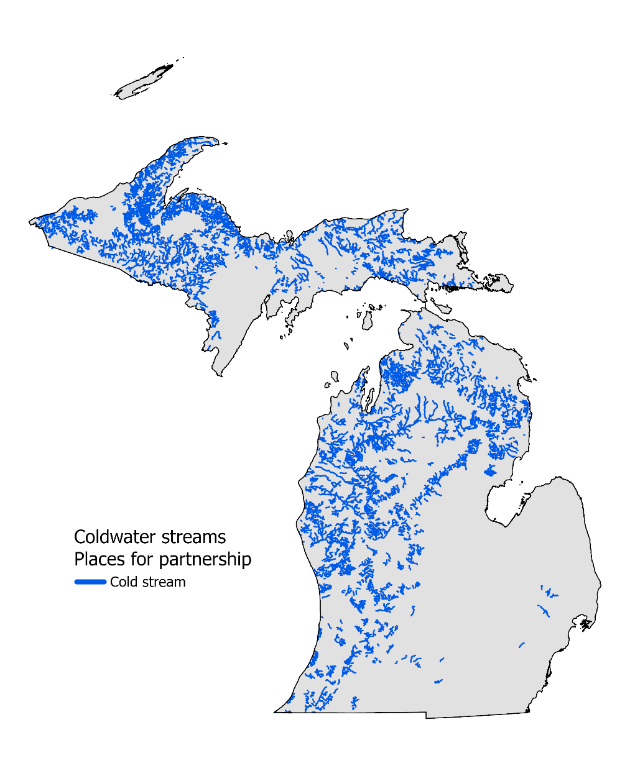
In this plan, Coldwater streams are defined as having average July water temperatures less than 67 F. Coldwater streams represent roughly 28% of the streams miles in the state and are, therefore, a relatively rare habitat type. Coldwater streams are dependent on groundwater inputs which arise from watersheds with coarse-textured glacial deposits of sand and gravel. Groundwater inputs are not only important for maintaining cold summer stream temperatures, but they also produce relatively stable stream flows. Coldwater streams are found primarily in the northern portion of Michigan’s Lower Peninsula and across the Upper Peninsula.
Why are coldwater streams important?
Coldwater streams are important features providing habitat not only for popular gamefish such as Brook Trout, Brown Trout and Rainbow Trout, but also for non-game fishes, aquatic insects and reptiles. Coldwater streams seasonally support large spawning runs of migratory fishes such as suckers, Steelhead and Pacific Salmon and play a critical role in the life-history of these species. Coldwater streams provide ample recreational opportunities including fishing and paddlesports and are represented by Michigan’s iconic and legendary trout streams including the Two-Hearted and Au Sable rivers. Healthy and intact coldwater streams influence the health and recreation potential of the Great Lakes by helping maintain water quality and supporting habitat for migratory fish species.
What is the health of coldwater streams?
Historically, coldwater streams were negatively affected by unregulated timber harvest, dams built for logging and power generation, pollution and fisheries overharvest. Over time, the health of coldwater streams has greatly improved, especially since the passage of the Clean Water Act in 1972. Today, many coldwater streams are still affected by dams and improperly sized road-stream-crossings which eliminate high gradient habitat, limit movement of aquatic organisms, sediment and woody material and alter natural flow and thermal regimes. The health of coldwater streams is also threatened by multiple factors including increases in impervious surfaces associated with urban development, loss of groundwater due to competing water uses and alteration of water temperature and streamflow due to climate change. Because groundwater inputs are important determinants of the quality and quantity of coldwater streams, protecting groundwater resources is critical for maintaining coldwater habitats, especially in the face of multiple threats.
Goals
- Improve understanding of availability and condition of coldwater stream habitats.
- Improve understanding of threats to and vulnerability of coldwater stream habitats.
- Conserve coldwater stream habitats through protection of groundwater resources, removal of barriers to aquatic organism passage, watershed and riparian protection and best management practices.
Focal Species
Arctic Grayling
Thymallus arcticus
State extirpated
Arctic Grayling were historically found in coldwater streams in the northern portion of the Lower Peninsula of Michigan and in at least one Upper Peninsula Coldwater Stream where they were likely introduced. In many coldwater streams, Grayling were the only native salmonid and often present in seemingly endless numbers. Grayling played an important role in Michigan’s history as an important food source and culturally important species for Native Americans and they also supported large commercial and recreational fisheries. However, construction of dams, unregulated timber harvest, overexploitation by anglers and predation/competition from non-native fish species led to the local extinction of Grayling and, by 1936, the species was extirpated from Michigan waters. Although multiple past attempts to reestablish Grayling have failed, a fresh approach to restoring the species has emerged. The Michigan Arctic Grayling Initiative (www.migrayling.org) was formed in 2016 and seeks to establish self-sustaining populations of Arctic Grayling. The initiative has more than 50 partners collaborating on the reintroduction. This initiative involves stocking eggs into in-stream incubators for the final phase of incubation and hatching. The first eggs introduced as part of this initiative were placed into the Manistee, Boardman-Ottaway and Maple River systems in May 2025.
Goals
- Establish self-sustaining populations of Arctic Grayling.
Wood Turtle
Glyptemys insculpta
State threatened
The Wood Turtle is a medium-sized turtle and has a carapace with raised concentric rings, often with radiating yellow and black lines. The underside of the shell lacks a hinge and is yellow with dark, oblong blotches along the outer edge. The highly sculptured carapace and unhinged, patterned plastron distinguish this species from other turtles in the state. Wood turtles are found primarily in or near river systems and associated riparian or floodplain habitats. They prefer clear, medium-sized rivers and streams (range 7 to 100 feet wide) with sand or sand and gravel substrates and moderate flow (Buech and Nelson 1991, Harding 1991). Wood Turtles require partially shaded, wet-mesic herbaceous vegetation such as raspberries, strawberries, grasses, willows, alders, algae and moss along or near rivers for foraging and thermoregulation. Wood Turtles also require sandy or sandy-gravelly areas along or in rivers for nesting (Lee 1999). Although Wood Turtles occur in a range of stream types, just over half (55%) of the observations statewide occur in coldwater streams. The majority (62%) of Wood Turtle observations in the Lower Peninsula occur in coldwater streams while about a third (38%) of the Wood Turtle observations in the Upper Peninsula occur in coldwater streams.
Goals
- Establish baseline status and distribution.
- Maintain existing populations.
- Determine the factors that currently limit Wood Turtle populations.
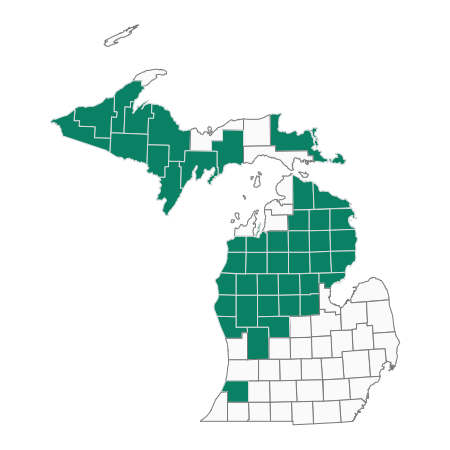
Call out box: Brook trout: a species of greatest information need. Brook Trout, the official state fish of Michigan, is a colorful cold-adapted species that is highly valued as a sportfish and for aesthetic reasons. Brook Trout were historically native to coldwater streams in the Upper Peninsula and the northern tip of the Lower Peninsula. By 1880, efforts were underway to propagate and extend the native range of range of Brook Trout in Michigan and by the early 1900s, populations were established in coldwater streams statewide (MacCrimmon and Campbell 1969). Although Brook Trout are not currently a Species of Greatest Conservation Need, there are concerns about the future of this species due to apparent declines across the state and known vulnerability to climate change (Maitland and Latzka 2022). Because these declines are not well understood, more monitoring and research is needed to understand population status and distribution, habitat conditions and to identify the factors that may limit Brook Trout populations. Such information is critical for developing conservation strategies to prevent future listing of this species.
Recommended actions:
- Conduct population and habitat surveys to establish baseline status and distribution.
- Determine the factors that limit Brook Trout populations.
- Identify resilient and vulnerable populations
- Implement management and regulatory actions that help maintain Brook Trout populations.
Call out box: how vulnerable are focal species to a changing environment? Climate vulnerabilities for focal species were determined by Hoving et al (2013) and Mothes et al. (2020) and climate vulnerabilities for Brook Trout were determined by Maitland and Latzka (2022). See threats section for more specifics about how climate change may affect species and habitats.
Climate vulnerability rankings are based on the likelihood and amount of change in species abundance or range by 2050 – extreme = extremely likely to substantially decrease or disappear; moderate = a modest decrease is likely.
| Climate vulnerability |
Arctic Grayling | High |
Wood Turtle | High |
Brook Trout | High |
Threats and conservation actions for habitat
Threats
Natural Systems Modifications
- Loss of natural riparian vegetation and floodplain habitats and placement of infrastructure (e.g., bridges) can result in bank instability and erosion. As river channels adjust to changes in sediment transport, bank armoring is often prescribed, resulting in further degradation and fragmentation of habitats (Smith et al. 2008).
- Removal of riparian vegetation increases stream temperatures, nutrients and sediments (Francis and Hass 2006; Sweeney et al. 2004) and reduction of terrestrial food sources (Studinski et al. 2017).
- Removal of log jams and other coarse woody structure results in loss of habitat and reduction in available cover for wildlife (Hanshue and Harrington 2016).
- Altered hydrology and increases in sediment and nutrient loading due to increases in impervious surfaces (Stanfield and Kilgour 2006).
- Reductions in stream flow due to surface water and groundwater extraction (Hamilton and Seelbach 2011).
Changing Weather Patterns
- Precipitation is very likely to become more extreme and less consistent, which could lead to increases in peak flows and lower base flows (Pryor et al. 2014).
- Coldwater species are sensitive to high summer temperatures and rely on coldwater lake and stream refugia that could be eliminated from a warmer climate or species could lose access due to fragmentation (Hayes et al. 1998).
- Altered flow regimes and temperatures in summer and winter could influence survival, growth, and recruitment for coldwater species (Zorn et al. 2007; Kanno et al. 2015; Maitland et al. 2022).
Agriculture and Aquaculture
- Increases in high flows and decreases in low flows, altering the natural hydrologic processes, when agricultural lands are drained through stream channelization and field tiling (Infante et al. 2006).
- Chemicals from pesticides and herbicides that leach into coldwater systems (Myers et al. 2021).
Energy Production and Mining
- Hydropower dams and pumped-storage facilities can alter flow regimes, thermal habitat, and wetland habitat. Though most dams in Michigan operate as run-of-river, there are still mechanical issues that cause changes in flow (Chalise et al. 2021).
- Mining and other energy activities such as fracking have the potential to use large volumes of water, thus potentially altering stream temperature and hydrology (Burton Jr. Et al. 2014; Sutton et al. 2024).
Transportation Corridors
- Altered water flows, sediment transport changes and fragmentation caused by road and pipeline crossings (Francis and Haas 2006)
- Increased inputs of salt and other pollutants from road crossings (Hanshue and Harrington 2016).
- Road and rail crossings can increase sediments and pollutants and be an issue locally, as well as have cumulative impacts (Francis and Haas 2006).
Pollution
- Increases in nutrient loadings from manure runoff from feedlots (COSEWIC 2011).
- Changes in thermal regimes from runoff and loss of riparian vegetation (Wehrly et al. 2006)
- Contaminants of emerging concern, including microplastics and pharmaceuticals (Alliance for the Great Lakes 2010; Pal et al. 2010).
Conservation Actions
Land & Water Management
- Work with local Department of Environment, Great Lakes and Energy (EGLE), health departments, governments and conservation districts on procedures related to updating sewage treatment systems, agricultural practices and septic systems within coldwater watersheds.
- Protect and manage habitat at existing sites supporting focal species.
- Support the maintenance of Michigan Department of Environment, Great Lakes and Energy’s Water Withdrawal Assessment Tool and work to understand the cumulative impacts of water withdrawal reach to reach.
- Support restoration initiatives to restore vegetated buffers near coldwater streams.
- Support and enhance regulatory programs that provide protections for wetlands and streams within important watersheds (i.e., Part 301 Inland Lakes and Streams, Part 303 Wetlands Protection, Part 305 Natural Rivers Program).
- Work with local foresters and wildlife managers on improving and enforcing best management practices for focal species habitat.
Raising Awareness
- Promote voluntary best management practices for forest and wildlife management.
- Provide recreational users, researchers and industry with best management practices for preventing the introduction and spread of invasive species.
- Work with Natural Resources Conservation Service, conservation districts, drain commissioners, private landowner programs and crop consultants to increase awareness of the Wildlife Action Plan and the conservation benefits of implementing best management practices especially near coldwater streams.
- Work with watershed groups to promote focal species and their habitats and ways to protect habitats through ordinances or best practices.
Conservation Designation and Planning
- Work with the Michigan Department of Transportation, county and municipal road commissions and Michigan Department of Environment, Great Lakes and Energy to inventory road stream crossings to identify priority sites to reduce sediment inputs and to ensure that best management practices are used during maintenance, repair and installation of culverts and bridges. [CRA; RgRA]
- Work with the Michigan Department of Environment, Great Lakes and Energy (EGLE) to develop storm water management plans in priority watersheds. [CRA; RRA; RgRA]
- Work with Natural Resources Conservation Service and conservation districts to target Farm Bill programs toward conserving focal species habitats and to focus conservation efforts on infiltration and groundwater recharge zones.
- Integrate Wildlife Action Plan priorities with local watershed management plans.
- Use principles of Natural Channel Design and consideration of all impacted species during restoration activities such as dam removal or culvert modification.
- Seek and assist partners in obtaining funding for habitat restoration through programs such as the Fisheries Habitat Grant.
- Work among divisions to develop and enhance best management practices near coldwater streams.
- Identify vulnerable watersheds and prioritize watersheds for protection.
Law and Policy
- Continue to administer an effective Michigan Department of Environment, Great Lakes and Energy protection program for wetlands, lakes and streams and provide incentives for conservation practices.
- Take appropriate enforcement actions for violations of the Invasive Species Order and maintain the Prohibited and Restricted Species list pursuant to the Natural Resources and Environmental Protection Act, 451 of 1994, as amended.
- Continue support for administration and enforcement of the Natural Rivers Program and develop new methodology for landowners to voluntarily restore violations related to clearing of buffers, sedimentation, etc.
Research and Monitoring
- Determine impacts of aquatic invasive species on coldwater streams and focal species (i.e., New Zealand Mudsnail).
- Promote use of two-stage channel design to protect focal species habitat.
- Assess stream and lake thermal refugia for coldwater species such as Arctic Grayling, Brook Trout, and others.
- Develop and implement targeted habitat surveys (using standardized sampling protocols as appropriate) as it relates to the restoration of Arctic Grayling, water withdrawal and dam removal.
- Promote and refine use of standardized sampling protocols that allow for comparability of streams across different spatial scales.
Threats and conservation actions for focal species
Arctic Grayling
Threats
Lack of Knowledge
- Lack of knowledge on what limits reestablishment of Arctic Grayling in coldwater streams.
Invasive and other Problematic Species, Genes and Diseases
- Brown Trout may outcompete Arctic Grayling and Brook Trout (Watson 2024; Zorn et al. 2020.
Energy Production and Mining
- Dams may limit connectivity among habitats for all life stages; on some coldwater streams, enhanced connectivity could allow brown trout establishment to the detriment of Arctic grayling and resident brook trout (Zorn et al. 2020).
- Dams may alter thermal habitat and flow regimes, reducing habitat suitability for Arctic Grayling.
Human Intrusions and Disturbance
- Illegal harvest.
Changing Weather Patterns
- Increasing water temperatures could decrease survival of Arctic Grayling and increase interactions with Brown Trout (Watson 2024).
Conservation Actions
Species Management
- Implement Michigan’s Arctic Grayling Initiative Action Plan.
Raising Awareness
- Create education and outreach opportunities providing information on the importance of Arctic Grayling, threats and best management practices to protect the species.
Law Enforcement and Prosecution
- Work with DNR Law Enforcement Division and local authorities to develop strategies that deter illegal harvest.
Law and Policy
- Protect Arctic Grayling habitat through the environmental permit review process.
Conservation Designation and Planning
- Identify coldwater streams that may support Arctic Grayling.
Research and Monitoring
- Improve understanding of factors that may limit survival and establishment of Arctic Grayling.
- Evaluate culture and stocking techniques that may enhance survival and establishment.
Wood Turtle
Threats
Lack of Knowledge
- Lack of information on current status, distribution and population viability.
- Lack of information on nesting and wintering sites.
Invasive and other Problematic Species, Genes and Diseases
- Nest predation from raccoons and skunks (Soule 1992, Harding pers. comm.)
Natural Systems Modifications
- Human activities such as construction of streamside cabins and roads, timber harvesting, grazing, agriculture, recreation, channel impoundments, stream channelization and bank stabilization have resulted in some habitat loss and degradation (Buech and Nelson 1991, Harding 1997).
Human Intrusions and Disturbance
- The most serious threat to this species is poaching for commercial pet trade and incidental collecting by the general public (Harding 1991, Soule 1992).
Transportation Corridors
- Mortality from road traffic and predation from raccoons and skunks which use roads as travel corridors (Soule 1992, Harding pers. comm.)
Changing Weather Patterns
- Changing weather patterns are predicted to substantially reduce suitable Wood Turtle habitat (Mothes et al. 2020).
Conservation Actions
Raising Awareness
- Create education and outreach opportunities providing information on the importance of Wood Turtle, threats and best management practices to protect the species.
Law Enforcement and Prosecution
- Work with DNR Law Enforcement Division and local authorities to develop strategies that deter illegal harvest.
Law and Policy
- Protect Wood Turtle habitat through the environmental permit review process.
- Implement the Wood Turtle Protections Guidance for Michigan DNR Lands.
Research and Monitoring
- Determine current status and distribution of Wood Turtle.
- Identify and monitor nesting and wintering sites as well as large populations.
- Conduct a threat assessment using existing species distribution models.
- Develop long-term population studies including viability studies.
How will we monitor?
Habitat
- Use and refine existing stream habitat monitoring protocols to develop standardized and scalable metrics that span the array of available coldwater habitats in the State of Michigan.
- Continue the development and integration of large-scale and remote sensed data to improve understanding of coldwater habitat at the landscape scale.
Arctic Grayling
- Use the existing Michigan Arctic Grayling Initiative partnership to coordinate evaluations of reintroduction stockings, habitat suitability by life stage (Goble et el. 2021) and movement among habitats.
- Explore the use of new technologies (e.g., eDNA) where possible to improve detection.
- Conduct targeted surveys to monitor changes in distribution and abundance.
- Conduct long-term surveys to determine population viability.
Wood Turtle
- Continue monitoring status, distribution, and population demographics with existing databases such as the state’s Natural Heritage Database, iNaturalist and HerpMapper
- Continue trapping, mark and recapture studies, and population modelling efforts throughout the species’ range
- Update occurrences in the state’s Natural Heritage Database
Places for partnership
This map was designed by partners to help them connect around important places for focal species. Working together on conservation actions on a voluntary basis provides great benefits to wildlife and people.
Links to other conservation plans
There has been a multitude of relevant planning efforts across the state and country over the past ten years. Bracketed superscripts throughout the Wildlife Action Plan indicate where the conservation action, goal, or monitoring strategy aligns with those from another plan. For conservation plans with distinct objectives, the objective or strategy number is also included. This linking of plans is meant to assist the expansion of partnerships.
[SFMP] Michigan State Forest Management Plan
LRBOI Nmégos (Arctic Grayling) Stewardship Plan (2019)
Michigan’s Arctic Grayling Initiative Action Plan (www.migrayling.org 2017)
Management Plan for Inland Trout in Michigan (Zorn et al. 2018).
Natural Rivers Plans – Pere Marquette, Two Hearted, Jordan, Rifle, Pigeon, Betsie, Pine, Upper Manistee, Au Sable, Boardman, Fox
Little Manistee Watershed Plan (LMWCC)
Watershed Assessment Plans – Little Manistee, Cheboygan, Au Sable, Manistee, Jordan River, Boardman, Muskegon, and the Upper Peninsula
Wood Turtle Protections Guidance for Michigan DNR Lands (Kleitch et al. 2024)
Literature Cited
Show all references
Buech, R.B. and M.D. Nelson. 1991. How to create wood turtle nesting areas. Draft report to Minn. DNR - Nongame Program.
Burton Jr., G. A., N. Basu, B. R. Ellis, K. E. Kapo, S. Entrekin and K. Nadelhoffer. 2014. Hydraulic "Fracking": Are surface water impacts an ecological concern? Environmental Toxicology and Chemistry 33(8):1679-1689. https://doi.org/10.1002/etc.2619
Chalise, D. R., A. Sankarasubramanian and A. Ruhi. 2021. Dams and climate interact to alter river flow regimes across the United States. Earths Future 9(4):e2020EF001816 https://doi.org/10.1029/2020EF001816
Daniel J. Isaak and Michael K. Young. 2023. Cold-water habitats, climate refugia and their utility for conserving salmonid fishes. Canadian Journal of Fisheries and Aquatic Sciences. 80(7): 1187-1206. https://doi.org/10.1139/cjfas-2022-0302
Goble, C. W., T, G. Zorn, N, A. Auer, J. M, Holtgren, D, W. Mays and A, W. Martell. 2021. Rating the potential suitability of habitat in Michigan stream reaches for Arctic grayling. Journal of Fish and Wildlife Management 12:540-553.
Hanshue, S.K. and A.H. Harrington. 2016. Grand River assessment. Michigan Department of Natural Resources Fisheries Report, Lansing, Michigan
Harding, J.H. 1991. “A twenty year wood turtle study in Michigan: Implications for conservation.” In Beaman, K.R., F. Caporaso, S. McKeown and M.D. Graff (eds.). Proceedings of the 1st International Symposium on Turtles and Tortoises: Conservation and Captive Husbandry - August 9-12, 1990. Chapman U., Orange, CA. pp. 31-35.
Hayes, D. B., W. W. Taylor, M. T. Drake, S. M. Marod and G. E. Whelan. 1998. The value of headwaters to brook trout (Salvelinus fontinalis) in the Ford River, Michigan, USA. Pages 175-185 in Headwaters: water resources and soil conservation. M. J. Haigh, J. Krecek, G. S. Rajwar and M. P. Kilmartin, editors. Oxford and IBH Publishing Co., New Delhi.
Kanno, Y., K. C. Pregler, N. P. Hitt, B. H. Letcher, D. J. Hocking and J. E. B. Wofford. 2015. Seasonal temperature and precipitation regulate brook trout young-of-the-year abundance and population dynamics. Freshwater Biology 61:88–99.
Lee, Y. 1999. Special animal abstract for Clemmys insculpta (wood turtle). Michigan Natural Features Inventory, Lansing, MI. 3 pp.
MacCrimmon, H. R., & Campbell, J. S. (1969). World distribution of brook trout, Salvelinus fontinalis. Journal of the Fisheries Board of Canada, 26(7), 1699-1725.
Maitland, B.M. and Latzka, A.W., 2022. Shifting climate conditions affect recruitment in Midwestern stream trout, but depend on seasonal and spatial context. Ecosphere, 13(12), p.e4308.
Michigan Department of Natural Resources. 2026. State forest management plan. Michigan Department of Natural Resources, Forest Resources Division and Wildlife Division, Lansing.
Michigan’s Arctic Grayling Initiative Action Plan (2017) www.migrayling.org
Mothes, C. C., Howell, H. J., & Searcy, C. A. (2020). Habitat suitability models for the imperiled wood turtle (Glyptemys insculpta) raise concerns for the species’ persistence under future climate change. Global Ecology and Conservation, 24, e01247.
Petty, J. T., J. L. Hansbarger, B. M. Huntsman and P. M. Mazik. 2012. Brook Trout movement in response to temperature, flow and thermal refugia within a complex Appalachian riverscape. Transactions of the American Fisheries Society 141(4):1060–1073.
Petty, J. T., P. J. Lamothe and P. M. Mazik. 2005. Spatial and seasonal dynamics of Brook Trout populations inhabiting a central Appalachian watershed. Transactions of the American Fisheries Society 134(3):572–587.
Studinski, J. M., A. W. Hafs, J. M. Niles and K. J. Hartman. 2017. The effects of riparian disturbance on the condition and summer diets of age-0 brook trout (Salvelinus fontinalis) in three central Appalachian streams. Canadian Journal of Fisheries and Aquatic Sciences 74:980–986.
Sutton, O. F., N. E. Balliston and J. S. Price. 2024. Mining and climate change alters water storage and streamflow dynamics of northern peatland-dominated catchments. Water Resources Research 60(12):e2024WR037310. https://doi.org/10.1029/2024WR037310
Tingley III, R.W., Infante, D.M., Dean, E.M., Schemske, D.W., Cooper, A.R., Ross, J.A. and Daniel, W., 2022. A landscape approach for identifying potential reestablishment sites for extirpated stream fishes: an example with Arctic grayling (Thymallus arcticus) in Michigan. Hydrobiologia 849:1397-1415.
Vincent, R. E. 1962. Biogeographical and ecological factors contributing to the decline of Arctic Grayling, Thymallus arcticus Pallas, in Michigan and Montana. Doctoral Dissertation. The University of Michigan, Ann Arbor.
Watson, N. M. 2024. Answering key uncertainties to successful reintroduction of Arctic grayling to Michigan streams. Ph. D. Dissertation. Michigan State University. East Lansing.
Zorn, T. G. and A. J. Nuhfer. 2007. Influences on brown trout and brook trout population dynamics in a Michigan river. Transactions of the American Fisheries Society 136:691-705.
Zorn, T.G., Hessenauer, J-M., Wills, T.C. 2020. Increasing connectivity of Great Lakes tributaries: Interspecific and intraspecific effects on resident brook trout and brown trout populations. Ecology of Freshwater Fish 29: 519– 532. https://doi.org/10.1111/eff.12563