
Littoral Zones
Contributors
Michigan Department of Natural Resources
Michigan Natural Features Inventory
Bay Mills Indian Community
Recommended Citation: Joseph K. Nohner, Kevin E. Wehrly, John M. Bauman, Justin J. Bopp, John T. Buszkiewicz, Arthur R. Cooper, Brian J. Gunderman, Michael R. Hillary, Katelyn B. King, Mica Kromrey, Kathleen B. Quebedeaux, Jack E. Taylor, and Frank N. Zomer. 2026. Michigan’s Wildlife Action Plan: 2025-2035, Littoral Zones. Michigan Department of Natural Resources, Lansing, MI.
What are littoral zones?
Littoral zones are the interface between the adjacent uplands and open water of lakes. They are defined as the area of the lake shallow enough to allow sufficient sunlight penetration for aquatic plants to grow. As such, littoral zones contribute significantly to the productivity of lakes. The size of the littoral zone in relation to the open water zone varies among lakes and is largely dependent on lake basin shape (e.g., the length and slope of the nearshore areas) and water clarity. In shallow lakes, the littoral zone may extend far from the shoreline, whereas lakes with steep drop-offs will have a narrow littoral band. Littoral zone plant communities are influenced by lake size, depth, water clarity, water chemistry, nutrient availability, wave energy and sediment composition. Shallow nearshore areas support emergent vegetation, such as sedges, rushes and cattails. As water depth increases from the nearshore area, floating-leaf plants such as white and yellow water lillies become more abundant in shallow waters. Submersed aquatic plants, such as wild celery and a variety of pondweeds, typically become more dominant as rooted floating-leaf species taper off and depths increase. Aquatic plants provide crucial habitats at different life stages of many fish species. They serve as substrates for eggs and refuges for juvenile fish, as well as provide habitat for species that require plants for their existence (O’Neal and Soulliere 2006). This diversity of plant life along with the microhabitats provided by sand, gravel, rock and structural habitat like fallen trees, are essential for all lake-dwelling species and provides the foundation for the aquatic food web.
Healthy littoral zones are equally important to wetland wildlife and often overlap with Great Lakes marsh and inland emergent wetlands. The distribution and abundance of aquatic plants directly influences foraging activity by ducks, geese and wading birds. Some species of shorebirds are reliant on shallow, vegetated areas, while others depend on forage found in the mudflats of the upper littoral zone (Soulliere et al. 2007). Waterfowl and shorebirds nest in emergent vegetation and often incorporate aquatic plant material in their nests. Other wetland-dependent species, including amphibians and reptiles, rely on this habitat for breeding, rearing and foraging. Several species of aquatic mammals spend much of their lives within the nearshore areas of the littoral zone.
Why are littoral zones important?
Healthy littoral zones contain a diversity of plant species that provide habitat and a food source for a diversity of animals, including invertebrates, fish, amphibians, reptiles, shorebirds, waterfowl and mammals. Aquatic plants growing in the littoral zones play an important role in maintaining the water quality by absorbing phosphorus, nitrogen and other nutrients in the water that could otherwise cause nuisance algal blooms. Healthy stands of floating-leaf and emergent plants protect the shoreline by dissipating erosive wave action. Native macroalgae like Chara also can stabilize sediments and improve water quality. Quality recreational fisheries depend directly on the condition of the littoral zone. Fish and wildlife resources associated with littoral zones in Michigan lakes are vast and provide significant recreational, ecological and economic benefits to the citizens of the state. Fishing, waterfowl hunting and wildlife viewing are important cultural activities collectively valued in the millions of dollars.
What impacts the health of littoral zones?
Human activity along the shorelines of lakes can dramatically affect the health of littoral zones. Routine, excessive and often dramatic removal of aquatic vegetation deemed to be a nuisance to shoreline property owners and the effects of invasive aquatic vegetation on native plants degrades the condition of littoral zone habitats. Sedimentation and nutrient runoff from mowed lawns, impervious surfaces, septic systems and other land cover alterations may smother fish eggs and increase nutrient pollution. Many littoral zones in Michigan have been altered by shoreline armoring, like riprap and seawalls and removal of fallen trees. Furthermore, attempts to address erosion from boat wakes, wind waves and other sources have led to widespread shoreline hardening through riprap and seawalls. The most significant alterations to littoral zones occur in large lakes and lakes in southern Michigan due to human disturbance (Wehrly et al. 2012). Additional threats to the habitats of littoral zones include loss of connectivity to populations in other lakes through culverts, dams and other obstructions (Cooper et al. 2022)
Goals
- Increase protection of littoral habitats which includes natural shorelines and associated wetlands, native riparian, emergent, floating and submersed vegetation and coarse woody habitat.
Call out box: Hardened shoreline. Construction of seawalls fragments the interface between the uplands and the littoral zone preventing free movements of wildlife. Seawalls also remove the natural energy dissipating capacity of a sloped shoreline and natural vegetation, resulting in increased erosive energy along the shoreline and increased scour in littoral zones.
Focal species
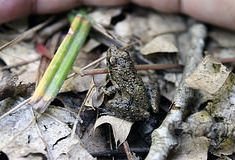
Blanchard’s cricket frog
Acris blanchardi
State threatened
Blanchard’s Cricket Frog is a member of the treefrog family. Adults have moist, warty skin that is gray, reddish brown, green, or olive colored. As their name implies, Blanchard’s Cricket Frogs are small, only 1.5 inches. Blanchard’s Cricket Frogs are the most aquatic of all tree frogs. Specific habitat needs include permanent ponds, lakes, slow-moving streams and rivers and other waterbodies and wetlands with aquatic vegetation and sparsely vegetated muddy or sandy shorelines or mud flats. Historically, Blanchard’s Cricket Frog occurred throughout the southern third of Michigan’s Lower Peninsula. There are recent observations (2014 – 2024) throughout the historical range, although information on abundance, potential viability and management needs of existing populations is lacking.
Goals
Assess the status and potential viability of extant populations.
Identify and maintain at least 10-20 viable populations distributed throughout the species’ range.
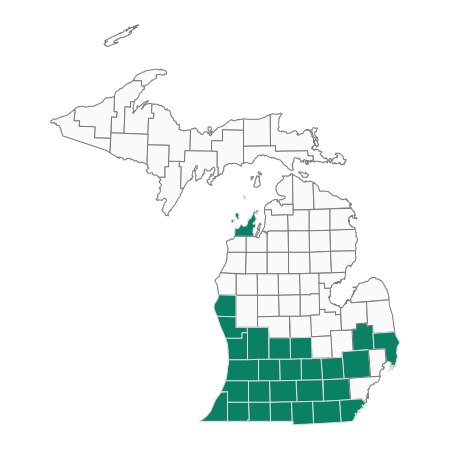
Eastern pondmussel
Sagittunio nasutus
State endangered
The Eastern pondmussel is a member of the unionidae family. It is elongate and compressed and contains a distinct posterior ridge with a low beak. The Eastern pondmussel is primarily found in lakes, ponds and slack-water areas of stream reaches (Mulcrone and Rathbun 2020). Historically, the Eastern pondmussel also has been found in connecting waterbodies of all five of the Great lakes, however, populations have declined primarily due to habitat destruction and invasive dreissenid mussels (COSEWIC 2017; MNFI 2025).
Goals
- Establish baseline status and distribution.
- Maintain existing populations.
Manoomin
Zizania palustris, Z. aquatica
State threatened (Z. aquatica)
There are two species of manoomin, Z. palustris and Z. aquatica. Throughout this plan we use manoomin to refer to these species, which are also referred to as mnoomin, mnomen and wild rice. Manoomin is an annual grass that grows in shallow areas of inland lakes, streams and Great Lakes coastal wetlands. It has cultural, spiritual and dietary importance for many indigenous peoples throughout Michigan. Because its grains are nutrient rich, it is an important food source for migrating waterfowl. The physical structure of manoomin stabilizes soft sediments and creates important habitat for predatory and young fishes. Manoomin is the main reason that Anishinaabe settled in the Great Lakes region and they have had a relationship with manoomin for thousands of years. Although manoomin was historically prevalent throughout the state, it is only found today in a fraction of historic locations. Currently Z. aquatica is listed as State Threatened and Z. palustris is included in this plan as a Species of Greatest Information Need in order to maintain monitoring and protection and to prevent it from becoming a Species of Greatest Conservation Need.
Goals
- Maintain existing populations and restore areas where manoomin has been lost.
- Fully incorporate goals of Michigan Wild Rice Stewardship Plan (MWRI 2025) into conservation planning at all levels.
- Establish statewide protections and harvest regulations.
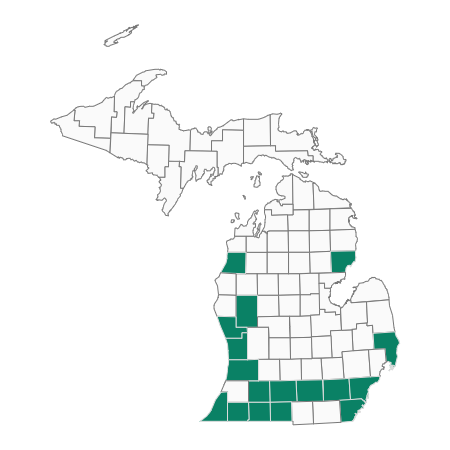
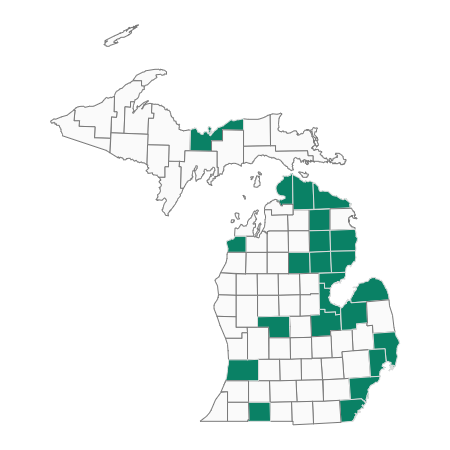
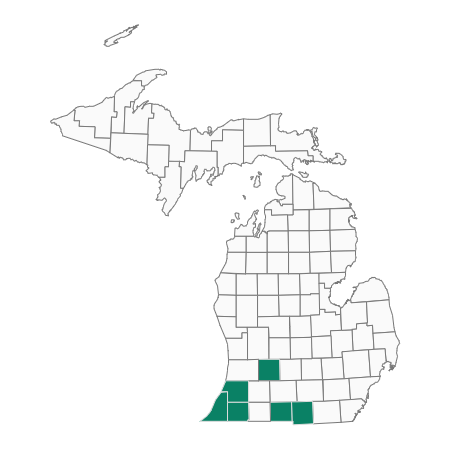
Range map shows Zizania aquatica, Zizania palustris is not currently tracked in the state’s Natural Heritage Database.
Pugnose Shiner
Notropsis anogenus
State endangered
The Pugnose Shiner is a small, straw-colored minnow with a distinctively small, upturned mouth. This species has a dark lateral band that extends from the tail through the eye and around the snout. The Pugnose Shiner inhabits clear, well-vegetated lakes and vegetated pools in low gradient rivers and requires dense stands of aquatic plants in nearshore areas (Scott and Crossman 1973; Trautman 1981). Historically this species was found in 18 watersheds in Michigan’s Lower Peninsula. In the past 20 years, the Pugnose Shiner has only been documented in five locations. This species is rare or critically imperiled throughout its range.
Goals
- Maintain existing populations.
- Develop a better understanding of critical life stage characteristics and habitat use.
Starhead Topminnow
Fundulus dispar
Special concern
The Starhead Topminnow is a small, olive-tan minnow-like fish with a series of red to brown spots arranged horizontally along the sides. This killifish has a conspicuous gold spot on top of the head. Starhead Topminnows inhabit shallow, quiet waters with an abundance of submersed vegetation (Becker 1983). This species is uncommon and any reductions in its populations or habitats could cause it to become state threatened.
Goals
- Establish baseline status and distribution.
- Develop a better understanding of critical life stage characteristics and habitat use.
Call out box: How vulnerable are focal species to a changing environment? Cooper et al. (2022), ITCMI (2016) and Hoving et al. (2013) determined climate vulnerabilities for focal species.
Climate vulnerability rankings are based on the likelihood and amount of change in species abundance or range by 2050 – high = likely to significantly decrease; moderate = a modest decrease is likely; stable = likely to remain unchanged.
Species | Climate Vulnerability |
Blanchard's cricket frog | High |
Eastern pondmussel | Moderate |
Manoomin | High |
Pugnose Shiner | Moderate |
Starhead Topminnow | Stable |
Call out box: Did you know? Below the water’s surface, woody habitat in the form of fallen trees provides crucial fish cover and substrate for aquatic insects. Fisheries research has demonstrated that removal of trees from the littoral zone can affect the distribution of fish (Sass 2006; Ahrenstorff et al. 2009). Fallen tree limbs that are above the water's surface provide perches for Cedar Waxwings and other birds, loafing and basking areas for turtles and waterfowl and feeding platforms for mink and other mammals.
Threats and conservation actions for habitat
Threats
Invasive / other problematic species, genes, & pathogens
- Invasive species can become established (e.g., Eurasian water milfoil, starry stonewort, invasive Phragmites, European frog-bit) and crowd out native species, especially when native aquatic plants are suppressed and shoreline vegetation is removed (O’Neal and Soulliere 2006).
- Introduction of non-native and invasive species such as Common Carp, red swamp crayfish, rusty crayfish and other species, may result in loss of high-quality aquatic plant beds, increased turbidity and nuisance algal growth (Dibble and Kovalenko 2009; Lodge et al. 1994).
- Invasive crayfish can negatively impact foodwebs through their impacts on the macroinvertebrate community (Ficetola et al. 2012; Lodge et al. 1994).
- Littoral zones can be greatly altered by the presence of invasive dreissenid mussels. The establishment of dreissenid mussels often sequesters nutrients in benthic biomass, stimulates toxic algal blooms and outcompetes native mussels (Schloesser et al. 1998, Baker and Levinton 2003, Knoll et al. 2008, Mayer et al. 2014).
- Introduction of new pathogens through fish stocking, bait, or other possible vectors could result in disease and die-offs of fish and waterfowl.
Natural system management & modifications
- Loss and degradation of habitat occurs when nearshore areas are filled to create swimming areas or largescale lake-bottom dredging is conducted for recreational boating (O’Neal and Soulliere 2006).
- Loss of connectivity between littoral and shoreland habitats occurs due to the hardening of shorelines with seawalls and riprap (Derosier 2004; Wehrly et al. 2012).
- Loss of emergent vegetation and stable shorelines due to lake-level control structures that establish artificially high lake levels in the open water months and abnormally low levels during periods of ice cover (O’Neal and Soulliere 2006).
- Simplification of habitats by the removal of coarse woody material in shallow water (Wehrly et al. 2012).
- Beach grooming, mechanical harvest and application of aquatic herbicides remove crucial native emergent and submersed vegetation which provides habitats for focal species (O’Neal and Soulliere 2006; Environment Canada 2011).
- Increased siltation and turbidity results from changes in land use along the shoreline and within the watershed (Becker 1983; Derosier 2004).
- Lake level modifications can potentially disrupt natural seasonal flooding of marshes and wetlands, increase shoreline erosion and affect the quality of spawning habitats.
- Large quantity ground or surface water withdrawals can lead to low water levels, which can result in loss of habitat for nearshore plants and animals.
Residential, commercial, & recreation areas
- Loss of emergent and submersed wetland habitats due to shoreline development (O’Neal and Soulliere 2006; Environment Canada 2011).
- Loss of riparian vegetation results in increased erosion, increased nutrient runoff and loss of habitat for amphibious and nearshore species.
Human intrusions & disturbances
- Shoreline erosion and degradation of emergent and submersed vegetation habitat due to wave energy and increased turbidity associated with operation of high-powered recreational boats and personal watercraft (O’Neal and Soulliere 2006; Francis et al. 2023).
Pollution
- Nutrient enrichment from local sources (e.g., lawn fertilizer, septic tanks) or watershed sources (e.g., agricultural, stormwater runoff) causes shifts in the phytoplankton community, increased turbidity, nuisance plant growth and fluctuations in dissolved oxygen concentrations (O’Neal and Soulliere 2006; Wehrly et al. 2015).
Conservation Actions
Land and water management
- Develop partnerships with lake associations and riparian landowners to restore and protect natural shorelines, large wood and aquatic vegetation. [CON;GRA; FD; KRA; MILP; MWRI]
- Implement Michigan’s Aquatic Invasive Species State Management Plan. [AIS; FD]
- Implement invasive species decontamination and prevention protocols. [AIS; CC; FD]
- Continue early detection response efforts for invasive species. [AIS; FD]
- Increase coarse woody habitat through installation of "fish sticks" in areas where they will not interfere with navigation.
Raising awareness
- Work with conservation districts and lake associations to inform the public of the ecological and cultural values of healthy Littoral Zone habitats and best management practices. [CON; GRA; FD KRA; MWRI]
- Use existing relationships with the Department of Environment, Great Lakes and Energy, Michigan Inland Lakes Partnership and the Michigan Natural Shoreline Partnership to curtail the spread of aquatic invasive species, abate nonpoint source pollution and maintain shoreline habitats. [FD]
- Collaborate with lake associations and boat retailers to promote best practices for operating boats and personal watercraft in a manner that minimizes littoral zone effects and the risk of aquatic invasive species transfer.
- Collaborate with outreach and education programs to develop freshwater mussel and SGCN species exhibits at state facilities.
- Collaborate on ongoing irrigation outreach programs to raise awareness on maintenance and improvement of irrigation systems to improve water use efficiency. [WUAC]
Conservation designation & planning
- Protect natural shorelines, aquatic vegetation and coarse woody habitat through the review of environmental permits. [FD]
- Establish best management practices and guidelines for use in developing and implementing aquatic vegetation management plans that achieve landowner goals while maintaining the biological integrity of the lake ecosystem. [FD]
Law & policy
- Continue to administer an effective Michigan Department of Environment, Great Lakes and Energy protection program for wetlands, lakes and streams and provide incentives for conservation practices.
- Take appropriate enforcement actions for violations of the Invasive Species Order and maintain the Prohibited and Restricted Species list pursuant to the Natural Resources and Environmental Protection Act, 451 of 1994, as amended. [AIS; FD]
- Update aquatic herbicide treatment reporting system to improve analysis of aquatic herbicide treatment effects on vegetation, fish, mussels and the lake ecosystem.
Research & monitoring
- Develop and implement quantitative habitat survey methods for inland lakes to establish assessments of vegetation communities and their management to improve analysis and understanding of distribution, abundance and relationships with Species of Greatest Conservation Need. [FD]
- Assess changes in hydrology due to actions that affect lake water levels such as lake level management, large quantity water withdrawals and other activities as relates to SGCN that rely on littoral zones. [FD]
- Refine species maps, habitat suitability models and priority maps based on field data, updated GIS layers and updated downscaled climate projections.
- Increase use of Score the Shore protocols by citizen scientists and other partners to map and assess inland lake shoreline habitats.
Threats and conservation actions for focal species
Blanchard’s cricket frog
Threats
Lack of knowledge
- Lack of information on distribution, relative abundance, population demographics and trends and limiting factors (Lee et al. 2000; Lanoo 2006).
Residential & commercial development
- Dispersal, recolonization opportunities and genetic mixing are restricted when connectivity between habitats is lost (Environment Canada 2011).
- Roads, particularly highways, can cause adult mortality and reduce or prevent gene flow between populations (Environment Canada 2011, Youngquist et al. 2017, Rainey 2023, Rainey et al. In review).
Invasive / other problematic species, genes, & pathogens
- Increased mortality through introductions of predatory fish species (Environment Canada 2011).
- Invasive species, such as common reed (Phragmites australis australis) can reduce availability of suitable habitat (Environment Canada 2011).
Pollution
- The viability of Blanchard’s cricket frog adults, larvae and eggs and successful reproduction may decrease due to bioaccumulation of contaminants (Environment Canada 2011).
Changing Weather Patterns
- Changes in precipitation and hydrology that result in increased flooding and/or drought can negatively impact Blanchard’s Cricket Frog survival, dispersal and/or habitat (Environment Canada 2011).
Conservation Actions
Conservation designation & planning
- Develop a conservation strategy for Blanchard’s cricket frog that focuses on viable/potentially viable populations and priority management needs for maintaining such populations.
Research & monitoring
- Develop and implement targeted surveys and monitoring using a standardized protocol and model to assess and monitor the distribution and status of Blanchard’s cricket frogs and identify viable populations.
- Determine threats and causes of population decline.
Eastern pondmussel
Threats
Lack of knowledge
- Lack of information on distribution and relative abundance.
Invasive / other problematic species, genes, & pathogens
- Invasive dreissenid mussels can cause mortality through fouling and food competition (Baker and Levinton 2003; Schloesser et al. 1998).
- Loss of genetic diversity and bottlenecks have been identified in Michigan populations (Scott et al. 2019).
Natural system management & modifications
- Direct mortality of Eastern pondmussels due to dredging or placement of fill in areas with existing mussel beds.
- Mortality of mussels due to aquatic herbicide treatments.
Conservation Actions
Conservation designation & planning
PM1. Develop and implement targeted surveys to update the distribution and status of Eastern pondmussel.
PM2. Develop a freshwater mussel hatchery and refine captive propagation, augmentation and reintroduction programs.
Manoomin
Threats
Lack of knowledge
- Educate the public, especially youth, about the cultural, spiritual and ecological value of manoomin
- Educate staff, leadership and legislators about the cultural, spiritual and ecological value of manoomin
- No State regulations for harvest or protections from intentional destruction
Invasive / other problematic species, genes, & pathogens
- Competition with invasive plants
- Loss of genetic diversity and potential hybridization with paddy rice
- Susceptible to diseases such as Brown Spot
Pollution
- Pollution including sulfates, turbidity and other pollutants harm manoomin populations.
Conservation Actions
Conservation designation & planning
- Establish protections and harvest regulations
- Clarify jurisdiction, responsibilities and expectations for manoomin protection and restoration
Research & monitoring
WR1. Establish and maintain a research agenda for manoomin
WR2. Work with Tribes to establish best practices supporting protection and restoration
WR3. Identify regional restoration goals for manoomin and appropriate ways of tracking them
Pugnose Shiner
Threats
Lack of knowledge
- Lack of updated information on distribution, relative abundance, limiting factors, biology, specific habitat needs, impacts of aquatic herbicides and vegetation removal on populations (Derosier 2004; COSEWIC 2013; FOC 2012).
Invasive / other problematic species, genes, & pathogens
- Increased mortality through introductions of predatory fish species (COSEWIC 2013).
- Removal of aquatic macrophytes through herbicides, mechanical harvesting and other means.
Conservation Actions
Research & monitoring
- Develop and implement targeted surveys to update the distribution and status of Pugnose Shiner using eDNA and other techniques.
- Determine specific habitat requirements for all life stages of the Pugnose Shiner.
- Quantify the extent to which aquatic herbicides and other vegetation management pose a significant threat to Pugnose Shiners.
- Evaluate potential effects of stocked fish predators on Pugnose Shiner populations.
Law & policy
- Use information from Pugnose Shiner and aquatic vegetation research to refine permit conditions for Aquatic Nuisance Control and Threatened and Endangered species permits to ensure adequate protection for this species during vegetation management activities.
Starhead Topminnow
Threats
Lack of knowledge
- Lack of information on distribution, relative abundance, limiting factors, biology, specific habitat needs and the impacts of aquatic herbicides and vegetation removal on populations (MNFI 2015).
Invasive / other problematic species, genes, & pathogens
- Increased mortality through introductions of predatory fish species.
Human intrusions & disturbances
- Removal of aquatic macrophytes through herbicides, mechanical harvesting and other means.
Conservation Actions
Research & monitoring
- Develop and implement targeted surveys to update the distribution and status of Starhead Topminnow.
- Determine specific habitat requirements for all life stages of the Starhead Topminnow.
- Quantify the extent to which aquatic herbicides and other vegetation management pose a significant threat to Starhead Topminnows.
- Evaluate potential effects of stocked fish predators on Starhead Topminnow populations.
Law & policy
ST4. Use information from Starhead Topminnow and aquatic vegetation research to refine permit conditions for Aquatic Nuisance Control and Threatened and Endangered species permits to ensure adequate protection for this species during vegetation management activities.
How will we monitor?
Habitat
- Use Michigan Department of Natural Resources Status and Trends surveys and targeted surveys to determine status of habitat.
- Continue Michigan Department of Environment Great Lakes and Energy aquatic habitat and water quality monitoring.
- Increase implementation and assessment of Cooperative Lake Monitoring Program surveys such as Score the Shore and Exotic Aquatic Plant Watch.
- Assess changes to shoreline habitats over time and at statewide scales using remote-sensed techniques.
- Partner with universities and nongovernmental organizations to develop methods for conducting, storing in a centralized database and analyzing aquatic vegetation data to address statewide research and monitoring needs.
Blanchard’s cricket frog
- Conduct targeted surveys and monitoring using a standardized protocol to determine current distribution, relative abundance, trends and habitat needs.
- Continue to update element occurrences in the state’s Natural Heritage Database.
Eastern pondmussel
- Conduct targeted surveys to determine current distribution, relative abundance, trends and habitat needs.
- Continue to update element occurrences in the state’s Natural Heritage Database.
Manoomin
- Work with Tribes and Michigan Wild Rice Initiative to establish standard monitoring protocols that can be adopted at a statewide level.
Pugnose Shiner
- Conduct targeted surveys to determine current distribution, relative abundance, trends and habitat needs.
- Continue to update element occurrences in the state’s Natural Heritage Database.
Starhead Topminnow
- Conduct targeted surveys to determine current distribution, relative abundance, trends and habitat needs.
- Continue to update element occurrences in the state’s Natural Heritage Database.
Places for partnership
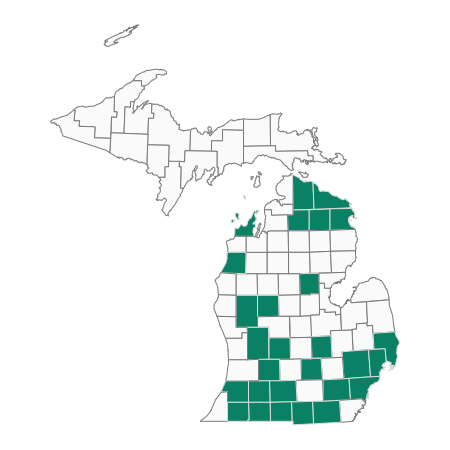
This map was designed by partners to help them connect around important places for focal species. Working together on conservation actions on a voluntary basis provides great benefits to wildlife and people.

This map is based on the number of focal species occurrences by watershed. Partners seeking a more detailed, interactive and up-to-date set of focal habitats that serve as conservation priorities for coldwater lakes and other Wildlife Action Plan chapters can find this information on the Department of Natural Resources’ Wildlife Action Plan Conservation Mapper, available at this website: [To be determined].
Links to other conservation plans
There have been a multitude of relevant planning efforts across the state and country over the past ten years. Bracketed superscripts throughout the Wildlife Action Plan indicate where the conservation action, goal, or monitoring strategy aligns with those from another plan. For conservation plans with distinct objectives, the objective or strategy number is also included. This linking of plans is meant to facilitate the expansion of partnerships.
[AIS] Michigan’s aquatic invasive species state management plan 2025 update. (QOL-AIS et al. in prep.)
[CC] Advancing the National Fish, Wildlife and Plants Climate Adaptation Strategy into a New Decade (National Fish, Wildlife and Plants Climate Adaptation Network 2021).
[CG] Conservation guidelines for Michigan Lakes and associated natural resources (O’Neal and Soulliere 2006)
[GRA] Grand River assessment (Hanshue and Harrington 2015)
[FD] Charting the Course: Michigan Department of Natural Resources Fisheries Division’s framework for managing aquatic resources. 2023-2029 Fisheries Division Strategic Plan. (Michigan Department of Natural Resources 2023).
[KRA] Kalamazoo River assessment (Wesley 2005)
[MILP] Michigan inland lakes partnership strategic plan (Michigan Inland Lakes Partnership 2021).
[MWRI] We all live together in a good way with Manoomin: Stewardship Guide (Michigan Wild Rice Initiative 2025)
[WUAC] 2022 Water Use Advisory Council Report (Water Use Advisory Council 2022)
Literature Cited
Show all references
Ahrenstorff, T.D., G.G. Sass and M.R. Helmus. 2009. The influence of littoral zone coarse woody habitat on home range size, spatial distribution and feeding ecology of largemouth bass (Micropterus salmoides). Hydrobiologia. 623:223–233.
Bailey, R.M., W.C. Latta and G.R. Smith. 2004. An atlas of Michigan fishes with keys and illustrations for their identification. Miscellaneous Publication of Museum of Zoology, University of Michigan, No. 192. Ann Arbor, Michigan.
Baker, S.M. and J.S. Levinton. 2003. Selective feeding by three native North American freshwater mussels implies food competition with zebra mussels. Hydrobiologia 505:97-105.
Becker, G.C. 1983. The fishes of Wisconsin. University of Wisconsin Press, Madison, Wisconsin.
Cooper, A. R., Wehrly, K. E., Yeh, S. K. and Infante, D. M. 2022. Influence of spatial extent on contemporary and future threat evaluation for imperiled fluvial fishes and mussels. Water 14:3464.
COSEWIC. 2013. COSEWIC assessment and status report on the Pugnose Shiner Notropis anogenus in Canada. Committee on the status of endangered wildlife in Canada. Ottawa. 32 pp.
COSEWIC. 2017. Eastern pondmussel (Ligumia nasuta): COSEWIC assessment and status report 2017. Committee on the status of endangered wildlife in Canada. Ottawa. 61 pp.
Derosier, A.L. 2004. Special animal abstract for Notropis anogenus (Pugnose Shiner). Michigan Natural Features Inventory. Lansing, Michigan. 2 pp.
Dibble, E.D. and K. Kovalenko. 2009. Ecological impact of grass carp: A review of the available data. Journal of Aquatic Plant Management. 47:1-15.
Durocher, P.P., W.C. Provine and J.E. Kraai. 1984. Relationship between abundance of largemouth bass and submerged vegetation in Texas reservoirs. North American Journal of Fisheries Management. 4:84-88.
Environment Canada. 2011. Recovery strategy for the Blanchard’s Cricket Frog (Acris blanchardi) in Canada. Species at Risk Act Recovery Strategy Series. Environment Canada, Ottawa.Ficetola, G.F., Siesa, M.E., De Bernardi, F. et al. 2012. Complex impact of an invasive crayfish on freshwater food webs. Biodiversity Conservation 21:2641–2651.
Fisheries and Oceans Canada (FOC). 2012. Adoption of the Recovery Strategy for the Pugnose Shiner (Notropis anogenus) in Canada.
Francis, J., J. Nohner, J. Bauman and B. Gunderman. 2023. A literature review of wake boat effects on aquatic habitat. Michigan Department of Natural Resources, Fisheries Report 37, Lansing.
Hanshue, S.K. and A.H. Harrington. 2015. Grand River Assessment. Michigan Department of Natural Resources Fisheries Report, Lansing, Michigan.
Hoving, C.L., Y. Lee, P.J. Badra and B.J. Klatt. 2013. Changing climate, changing wildlife: a vulnerability assessment of 400 species of greatest conservation need and game species in Michigan. Wildlife Division Report No. 3564. Lansing, Michigan. 82 pp.
Inter-Tribal Council of Michigan, Inc. (ITCMI). 2016. Michigan tribal climate change vulnerability assessment and adaptation planning: Project report. Accessed at: http://www.itcmi.org/wp-content/uploads/2022/03/2016_ITCMI_Report.pdf
Knoll, L.B., O. Sarnelle, S.K. Hamilton, C. E.H. Kissman, A.E. Wilson, J.B. Rose and M.R. Morgan. 2008. Invasive zebra mussels (Dreissena polymorpha) increase cyanobacterial toxin concentrations in low-nutrient lakes. Canadian Journal of Fisheries and Aquatic Sciences 65: 448-455.
Lannoo, M. 2006. Amphibian declines: The conservation status of United States species. University of California Press. Berkeley.
Latta, W.C. 2005. Status of Michigan’s endangered, threatened, special-concern and other fishes. 1993-2001. Michigan Department of Natural Resources, Fisheries Research Report. Ann Arbor, Michigan.
Lee, Y., D.A. Hyde and J. Legge. 2000. Special animal abstract for Acris crepitans blanchardi (Blanchard’s cricket frog). Michigan Natural Features Inventory. Lansing, Michigan. 4 pp.
Lodge, D.M., Kershner, M.W., Aloi, J.E. and Covich, A.P. (1994), Effects of an omnivorous crayfish (Orconectes rusticus) on a freshwater littoral food web. Ecology, 75: 1265-1281. https://doi.org/10.2307/1937452
Manoomin Writing Collaborative. 2025. We all live together in a good way with Manoomin. Michigan Wild Rice Initiative. Accessed at: https://www.itcmi.org/home/departments/environmental-services/manoomin-stewardship-guide
Mayer, C.M., L.E. Burlakova, P. Eklöv, D. Fitzgerland, A.Y. Karatayev, S.A. Ludsin, S. Millard, E.L. Mills, A.P. Ostapenya, L.G. Rudstam, B. Zhu and T.V. Zhukova. 2013. The benthification of freshwater lakes: Exotic mussels turning ecosystems upside down. In Nalepa, T.F. and D.W. Schloesser (eds), Quagga and zebra mussels: Biology, impacts and control, 2nd ed. CRC Press, Boca Raton, Florida: 575-586.
Michigan Quality of Life Agencies Aquatic Invasive Species Team et al. (QOL-AIS et al.). In prep. Michigan’s aquatic invasive species state management plan 2025 update.
Michigan Department of Natural Resources (DNR). 2023. Charting the Course: Michigan Department of Natural Resources Fisheries Division’s framework for managing aquatic resources. 2023-2029 Fisheries Division Strategic Plan. https://www.michigan.gov/dnr/-/media/Project/Websites/dnr/Documents/managing/fisheries/Strategic-Plan_2023.pdf?rev=c3969e99c8784345bd72dba4af257a16
Michigan Natural Features Inventory (MNFI). 2025. Rare species explorer (Web application). Accessed at https://mnfi.anr.msu.edu/species
Mulcrone, R.S. and J.E. Rathbun. 2020. Pocket field guide to the freshwater mussels of Michigan (2nd ed.). Michigan Department of Natural Resources, 78 pp.
Nalepa, T. F. and D. W. Schloesser. 2013. Quagga and zebra mussels: Biology, impacts and control (2nd ed.). CRC Press, Boca Raton, Florida.
National Fish, Wildlife and Plants Climate Adaptation Network. 2021. Advancing the national fish, wildlife and plants climate adaptation strategy into a new decade. Association of Fish and Wildlife Agencies, Washington, DC.
Newton, T.J., Johnson, N.A. and Hu, D.H., 2023, U.S. Geological Survey science vision for native freshwater mussel research in the United States: U.S. Geological Survey Circular 1511, 15 p., https://doi.org/10.3133/cir1511.
O’Neal, R.P. and G.J. Soulliere. 2006. Conservation guidelines for Michigan Lakes and associated natural resources. Michigan Department of Natural Resources, Fisheries Special Report 38, Ann Arbor, Michigan.
Rainey, T.A. 2023. Persistence and population genetics of a threatened frog in a fragmented landscape. M.S. Thesis, Central Michigan University, Mt. Pleasant, Michigan. 107 pp.
Rainey, T.A., K.E. Nicholson, C.P. Wells and B.J. Swanson. In review. High genetic diversity but low connectivity of peripheral, threatened populations of the Blanchard’s cricket frog.
Sass, G.G., J.F. Kitchell, S.R. Carpenter, T.R. Hrabik, A.E. Marburg & M.G. Turner. 2006. Fish community and food web responses to a whole-lake removal of coarse woody habitat. Fisheries 31: 321–330.
Schloesser, D.W., W.P. Kovalak, G.D. Longton, K.L. Ohnesorg and R.D. Smithee. 1998. Impact of zebra and quagga mussels (Dreissena spp.) on freshwater unionids (Bivalvia: Unionidae) in the Detroit River of the Great Lakes. The American Midland Naturalist 140(2):325-342.
Scott, M.W., Morris, T.J. and D.T. Zanatta. 2020. Population structure, genetic diversity and colonization history of the eastern pondmussel, Sagittunio nasutus, in the Great Lakes drainage. Aquatic Conservation: Marine and freshwater Ecosystems 30(4):631-646.
Scott, W.B. and E.J. Crossman. 1973. Freshwater fishes of Canada. Bulletin 184. Fisheries Research Board of Canada. 966 pp.
Soulliere, G.J., B.A. Potter, D.J. Holm, D.A. Granfors, M.J. Monfils, S.J. Lewis and W.E. Thogmartin. 2007. Upper Mississippi River and Great Lakes Region Joint Venture waterbird habitat conservation strategy. U.S. Fish and Wildlife Service, Fort Snelling, Minnesota. 68 pp.
Trautman, M.B. 1981. The fishes of Ohio. Ohio State University Press, Columbus. 782 pp.
Water Use Advisory Council. 2022. 2022 Water Use Advisory Council report. https://www.michigan.gov/egle/-media/Project/Websites/egle/Documents/Groups/WUAC/Reports/Report-2022-WUAC.pdf?rev=e5c3fba2de7f49f394388ecf060f8854
Wehrly, K.E., L. Wang, J.E. Breck and L. Szabo-Kraft. 2012. Assessing local and landscape patterns of residential shoreline development in Michigan lakes. Lake and Reservoir Management 28:158-169.
Wehrly, K.E., D. Hayes and T.C. Wills. 2015. Status and trends of Michigan inland lake resources 2002-2007. Michigan Department of Natural Resources, Fisheries Report 08, Lansing, Michigan.
Wesley, J.K. 2005. Kalamazoo River Assessment. Michigan Department of Natural Resources, Fisheries Division, Special Report 35, Ann Arbor, Michigan.
Youngquist, M.B., K. Inoue, D.J. Berg and M.D. Boone. 2017. Effects of land use on population presence and genetic structure of an amphibian in an agricultural landscape. Landscape Ecology 32:147-162.